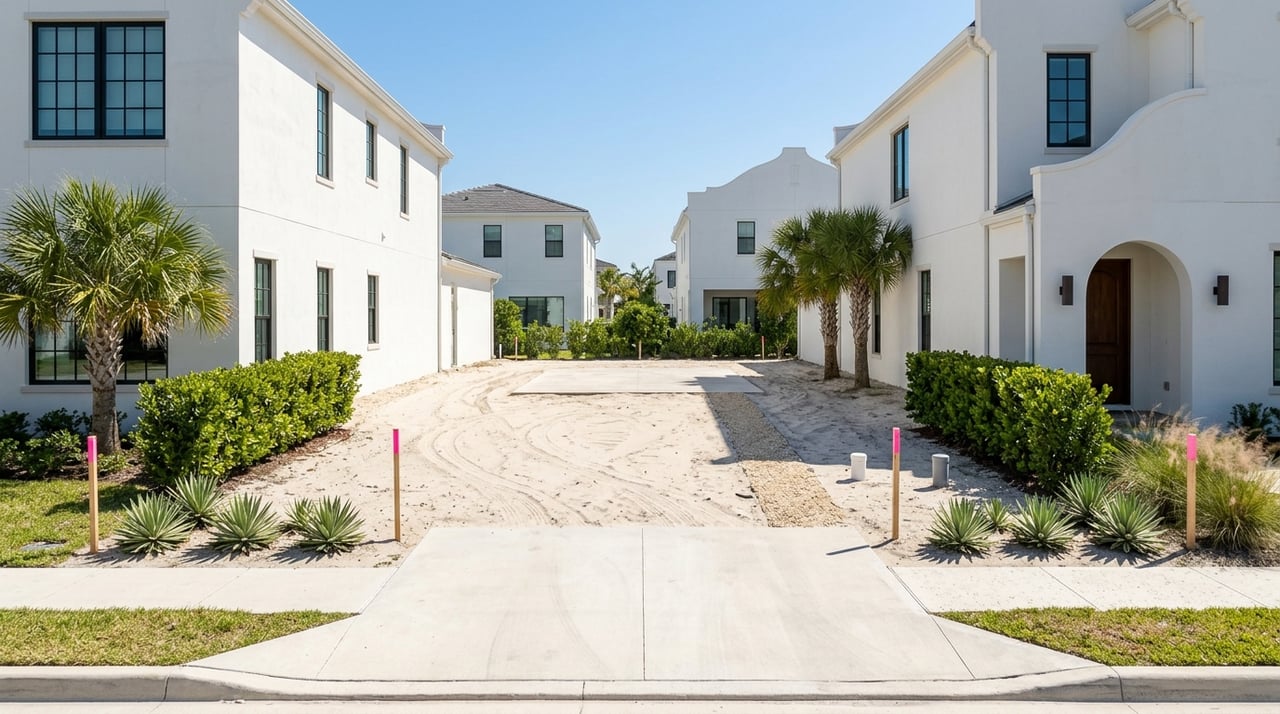
What to Know About Building in Inlet Beach Florida
April 16, 2026
April 16, 2026
Thinking about buying a lot in Inlet Beach and building from the ground up, or redeveloping an older site? It can be a smart move, but only if you understand the rules that shape what can actually be built. In a market where location, density, height, flood risk, and overlay standards can change the economics fast, a little upfront diligence can save you a lot of time and money. Let’s dive in.
Inlet Beach is not a simple one-size-fits-all market for land. Site-specific development must comply with Walton County’s base zoning rules and the additional standards in the Inlet Beach Neighborhood Plan overlay.
That matters because two lots with similar size and location can have very different redevelopment potential. A parcel’s zoning district, overlay rules, utility access, floodplain status, and coastal constraints can all affect density, design, timeline, and carrying costs.
Before you price a lot or assume a build program, start with Walton County’s interactive mapping tools. The county’s General and Planning Interactive Maps let you review parcels, future land use, wetlands, flood zones, beach mouse tiers, elevation contours, planning overlays, height limits, Coastal Construction Control Line data, and CBRS/OPA layers.
This is the fastest way to build an early feasibility picture. It helps you screen whether a lot looks straightforward, or whether it may involve extra layers of environmental, floodplain, or coastal review.
A lot in Inlet Beach should never be underwritten on lot size alone. The zoning district and overlay structure often determine whether the best use is a single-family build, a live/work concept, a small mixed-use project, or a more limited residential play.
Walton County’s Neighborhood Infill district standards apply to certain unplatted or vacant parcels totaling 10 contiguous acres or less that are surrounded by development. This district can allow single-family, multifamily, neighborhood commercial, professional office, live/work, artisanal, and passive recreation uses.
Density ranges from 2 to 8 dwelling units per acre, and compatibility with surrounding development is a core standard. For non-residential intensity, the district allows a maximum FAR of 0.50 and ISR of 0.60.
The Inlet Beach plan’s Residential Preservation district is designed to maintain established residential character. In this district, accessory structures are limited to 800 square feet.
There are also added compatibility rules for taller residential projects. If a new residential project is over two stories and sits near Residential Preservation Zones that are more than 75 percent one- or two-story dwellings, a 50-foot setback can apply.
The Workplace/Live-Work overlay is one of Inlet Beach’s more unique land-use tools. It sits on top of Neighborhood Infill and allows limited commercial uses on residential lots.
The key limit is that the non-residential component cannot exceed 50 percent of the total building square footage. If the property includes non-residential uses, the overlay calls for 10-foot front, 15-foot side, and 20-foot rear setbacks, side or rear parking, and a sidewalk along N. Orange Street frontage for projects other than a single-family home.
If you are evaluating a lot on or near a more active corridor, Village Mixed Use standards may be especially relevant. VMU allows residential, limited lodging, civic, recreation, commercial, live/work, office, and artisanal uses, with maximum residential density of 12 units per acre and a maximum height of four stories above ground level.
The Inlet Beach plan also requires side or rear parking, buffers at district edges, and a six-foot sidewalk along public street frontage for development other than a single-family home. For Neighborhood Commercial areas, the Inlet Beach plan allows a FAR of 0.50, ISR of 0.60, and generally caps mixed-use and non-residential height at 40 feet.
In Inlet Beach, density is one of the first numbers to verify because it directly affects value and exit strategy. The Inlet Beach Neighborhood Plan says that north of US 98, residential density must be compatible with surrounding development and cannot exceed 8 dwelling units per acre.
South of US 98, the maximum density is generally 4 units per acre with central water and sewer service, 3 units per acre with central water only, and certain parcels marked Maximum 8 DUA on the plan map may use 8 units per acre instead. That means utility service is not just a technical issue. It can materially change your build assumptions.
A lot may look large enough on paper, but setbacks, easements, and height-related rules can shrink the usable envelope. Walton County’s base setback standards set single-family setbacks in unincorporated areas at 20 feet front, 7.5 feet side, and 15 feet rear.
For multifamily and other primary structures, the dimensions can be different, and certain taller buildings may trigger larger setbacks. In South Walton, the code says that for some non-residential and multifamily uses adjacent to existing single-family homes, the abutting setback line increases by one-half foot for each foot of building height above 36 feet.
Setback measurements can also be affected by access easements. Walton County notes that in some situations the measurement line shifts to the easement rather than the property line, which is why a current survey matters early.
Height is another area where investors sometimes make bad assumptions. The county’s code specifically notes that the Inlet Beach Neighborhood Plan provides its own limits on height, so you should not underwrite an Inlet Beach parcel using only the broader countywide South Walton ceiling.
Under the Inlet Beach plan, single-family detached homes are capped at 50 feet. Multifamily buildings are capped at 40 feet, and mixed-use and non-residential projects in Neighborhood Commercial and VMU are also generally limited to 40 feet or four stories, depending on the district.
Coastal lots often carry the most upside, but they can also carry the most review risk. Walton County’s coastal building zone ordinance applies to certain areas within the floodplain and wind-borne debris region, plus FEMA V-zones, and structural plans in that zone must be certified by a Florida-registered architect or engineer.
If a parcel is seaward of the Coastal Construction Control Line, review can become even more specialized. Walton County says it will not approve construction seaward of the CCCL until all required Florida DEP and other permits are in hand, and it will not issue a development order or permit for construction on a new parcel that lies entirely seaward of the CCCL. Florida DEP also states that a permit is generally required for construction and excavation seaward of the CCCL, as noted in the county’s coastal development regulations.
Floodplain status can change both construction cost and design approach. Walton County’s building requirements state that in AE zones, the finished floor must be at least 1 foot above Base Flood Elevation, while VE and Coastal A zones require the lowest horizontal structural member of the lowest floor to be at least 1 foot above BFE.
If you need parcel-level flood guidance, the county says flood status can be checked through the flood information request resources, county maps, or the Floodplain Manager. For smaller projects in approximate A zones, the county also offers a BFE determination form.
Some of the most expensive lot mistakes happen when buyers skip environmental screening. Walton County’s COBRA and CBRS guidance notes that NFIP flood insurance is barred for structures built or substantially improved on or after a zone’s applicable designation date in those protected areas.
The county also advises buyers to check if a parcel is in or near a CBRA before obtaining a building permit. In addition, the county’s beach mouse habitat guidance says Tier 1 parcels require coordination with the U.S. Fish and Wildlife Service before development, while Tier 2 parcels require recorded conservation measures and wildlife lighting review.
On top of that, Walton County’s building permit review page specifically flags lots on coastal dune lakes, tributaries, wetlands, and other environmentally sensitive areas. If a parcel touches one of those features, you should plan for more diligence before you commit to a build schedule.
For teardown and infill sites, stormwater is not just a permit box to check. Walton County’s single-family stormwater guidance emphasizes limiting site disturbance and fill, and the submission checklist requires items like contours, site plans, impervious-area calculations, soils information, drainage calculations, and a final topographic survey with completion photos.
That means lot coverage assumptions should be tested early. The more aggressive the design, the more important stormwater planning becomes to the overall timeline and budget.
Not every Inlet Beach lot is an interior residential play. The Inlet Beach plan explains that commercial uses have developed along US 98 and that future neighborhood-scale commercial should be encouraged there, which can make corridor-facing parcels a very different underwriting exercise from interior homesites.
If a lot fronts US 98 or C.R. 30A, scenic-corridor review may apply. Walton County’s scenic corridor review standards state that projects in the US 98/331 corridor other than single-family residential subdivisions go to the Design Review Board, while C.R. 30A corridor projects are still subject to corridor standards even without DRB approval.
Timing risk matters almost as much as zoning risk. Walton County now receives planning applications through EnerGov, and the county states that a pre-application meeting is required before most planning applications will be accepted.
The county also says planning review must be completed before building permit review can proceed for single-family homes, swimming pools, and most accessory structures. For larger projects, the development review threshold criteria show when a proposal becomes major development and must move through the TRC, Planning Commission, and Board of County Commissioners.
If you are evaluating a teardown, infill lot, or small redevelopment opportunity, use this quick screen before you lock in pricing:
Building or redeveloping a lot in Inlet Beach can create meaningful upside, but the best opportunities usually come from disciplined underwriting rather than optimistic assumptions. If you want a local, development-minded read on a parcel, Darren Koenenn can help you evaluate land potential, constraints, and strategy with a builder-informed perspective.
Stay up to date on the latest real estate trends.


We pride ourselves in providing personalized solutions that bring our clients closer to their dream properties and enhance their long-term wealth. Contact us today to discuss all your real estate needs!
KOENENN GROUP
2048 W COUNTY HIGHWAY 30A STE 107 SANTA ROSA BEACH FL 32459