What Your Deed Actually Covers When You Buy Beachfront in Seagrove Beach
September 17, 2026
September 17, 2026
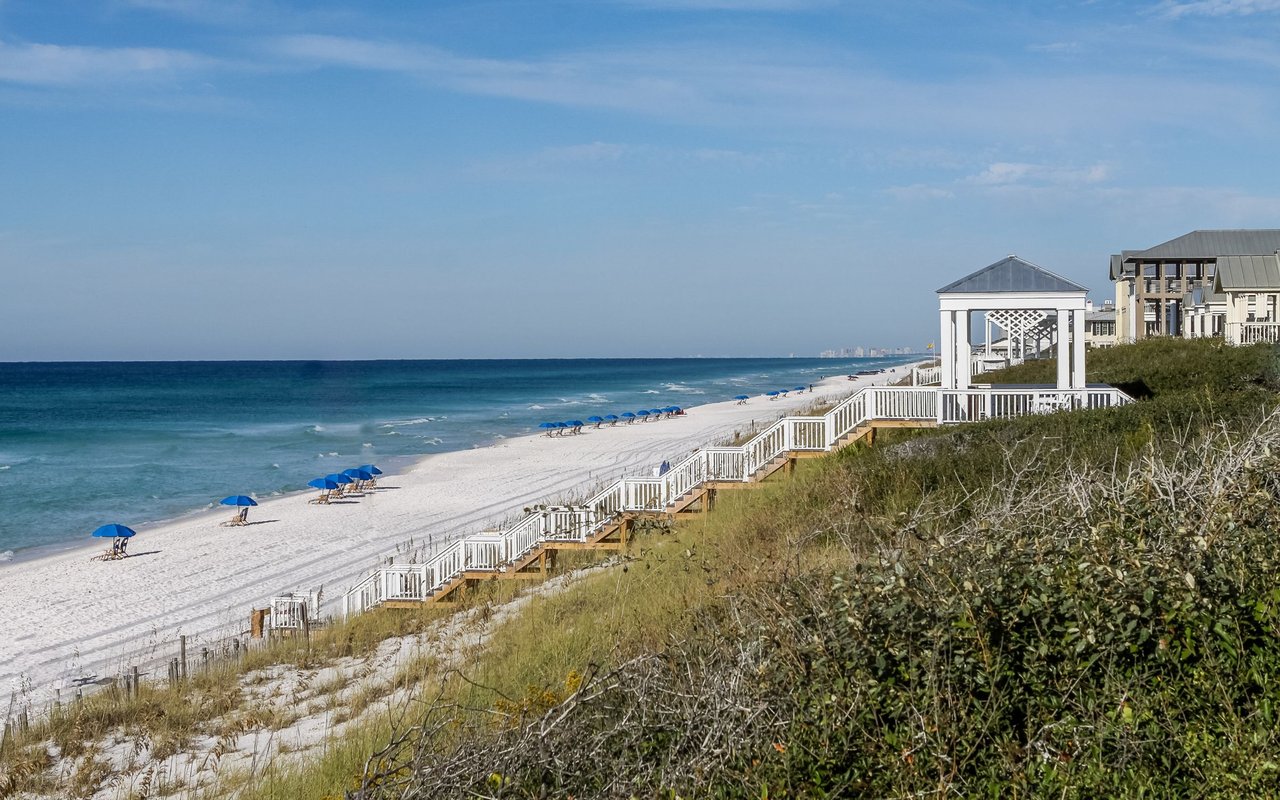
Two houses sit three lots apart on the same stretch of sand east of San Juan Street in Seagrove Beach. Both are listed as beachfront. Both show a private crossover in the photos. But if you stood on the dry sand in front of either one, the rules for who else is allowed to stand there with you would be different, and neither the listing sheet nor the plat map would tell you why.
The difference isn't lot size, price, or how the house was marketed. It comes down to a single legal fact buried in county litigation records: which of three categories a 2023 court settlement placed that specific parcel into. That settlement, not the deed language a seller's attorney drafted decades ago, is what actually determines whether your future beach is yours alone, shared under strict rules, or open to the public the same way a county park would be.
For years, the question of who could use the dry sand in front of a private home in Walton County was governed by something called customary use, a legal doctrine that lets the public keep using land it has used, without dispute, for a very long time. In 2018, Walton County sued to have customary use formally recognized across 1,194 privately owned beachfront parcels. The case dragged on for years and ended not with one ruling but with three different outcomes, depending on how each property owner responded.
Owners who fought the suit with counsel and won got a court finding that customary use does not exist on their property. That's the largest group, and on those parcels the beach in front of the house is private in the way most buyers assume beachfront means private.
A second group of roughly 39 owners chose to settle rather than litigate. In exchange for dismissal from the case, they agreed to let the public use a 20-foot strip of their dry sand, measured landward from the wet sand line, for specific limited purposes. County and legal sources call this the transitory zone, and it's the arrangement most likely to surprise a new owner who didn't know to ask about it.
A third group, about 95 parcels, never objected to the lawsuit at all. Because Florida law required the county to prove its case only where an owner disputed it, the judge found that public customary use rights exist on those specific properties, full stop. No settlement, no negotiated 20 feet. An outright judicial finding.
Three legal categories, one settlement, and no way to tell which one applies to a given house just by looking at it or reading a standard listing description.
If a Seagrove Beach property falls into the settled group, the rules aren't vague. According to the settlement terms as reported by Walton County news coverage and outlined by the Surfrider Foundation, the public can use that 20-foot strip for:
What the zone does not allow is just as specific. No umbrellas or tents. No access to the zone by cutting through the owner's private beach area to reach it. And if a beachgoer is challenged for being outside the 20 feet, the burden falls on them to prove they were standing in the transitory zone and not on the owner's private sand, a detail Surfrider's legal analysis flagged as one of the settlement's more contentious provisions.
For an owner or a buyer, that 20-foot number is not trivial. On a typical Seagrove lot, it can be the difference between a beach that functions as a true private amenity and one where lounge chairs, coolers, and walking traffic are a daily fact of life for seven hours out of every day.
This isn't settled history sitting quietly in a court file. By June 2026, Walton County sheriff's deputies had already responded to almost 100 beach trespassing calls that year, in a report that named Seagrove Beach specifically and pictured a public stretch of sand there bounded on both sides by private property. The same report quoted longtime local surfer Dave Rauschkolb describing the tension along that exact stretch.
"It's tragic. I can't go to the beach without being stressed out."
A separate NPR report published in early September 2026 covered a related lawsuit: musician Brian Littrell, whose property sits a few miles from Seagrove Beach, is suing the local sheriff over how trespassing disputes on private beach are enforced. That same NPR reporting quoted the sheriff saying deputies haven't made a single trespassing arrest on the beach in roughly a decade, choosing instead to talk both sides down. Part of what's driving the friction is simple math: the June report noted more than 17,000 newcomers have moved into 30A beach towns since 2020, a roughly 24 percent population increase. More people are showing up to a coastline where the private sand never actually got smaller.
None of this means buying beachfront in Seagrove Beach is a bad idea. It means the legal status of the sand in front of a specific house is now a live, actively enforced, occasionally litigated fact, not a settled footnote you can skip past on the way to the kitchen photos.
| Category | Roughly how many parcels | What the public can do | Hours |
|---|---|---|---|
| Fully private (owner won or was dismissed) | More than 1,100 of the 1,194 named parcels | Nothing, absent a separate recorded public easement | N/A |
| Settled transitory zone | About 39 | Walk, swim, surf, sit or lie on a towel in the 20-foot strip | 9 a.m. to 4 p.m. |
| Judicial customary use finding | About 95 | Same public recreational uses recognized on the underlying beach | Not time-limited by the settlement |
The gap between the first row and the other two is the gap between what most buyers picture when they hear beachfront and what they may actually be closing on.
A parcel's category isn't something a listing agent invents or a seller discloses out of habit. It has to be traced back to the litigation record for that specific property. Before you write an offer on beachfront or near-beach property in Seagrove Beach, work through this list:
None of these steps are exotic. They're the same due diligence a careful buyer already applies to survey lines and flood zones. The customary use category just hasn't made it onto most buyers' checklists yet, largely because it's a fact pattern specific to Walton County and rarely explained in plain terms before closing.
Does a fully private beach parcel mean no one can ever walk in front of my house? No. The wet sand below the mean high water line remains open to the public across the entire Walton County coastline regardless of a parcel's customary use category. What changes by category is the dry sand above that line.
If my parcel is in the settled transitory zone, can I still put out my own beach furniture? Yes. The settlement governs public use of the 20-foot strip, not the owner's own use of their property. Owners and their guests retain full use of their beach.
Can a parcel's category change after I buy? The core litigation is closed. Final judgments were entered in early 2024, and the county's window to refile against non-settling parcels expired at the end of May 2024, so the three categories described here have been stable for more than two years. A local real estate attorney can still confirm the current status of the specific parcel you're considering, since a few individual parcels worked through appeals on their own timeline.
Buying on Florida's Gulf coast has always meant buying more than a structure. In Seagrove Beach right now, it means buying a specific, documented legal relationship to the sand in front of the house, one that a careful search of the litigation record can confirm before you're past your inspection period. That's the kind of verification a numbers-first advisor builds into the process rather than leaving to chance.
If you're evaluating a beachfront or near-beach property in Seagrove Beach and want the customary use status checked before you write an offer, Koenenn Group can walk through the parcel history with you and connect you with the right local resources to confirm it. Schedule a consultation before your next showing.
Stay up to date on the latest real estate trends.




We pride ourselves in providing personalized solutions that bring our clients closer to their dream properties and enhance their long-term wealth. Contact us today to discuss all your real estate needs!
KOENENN GROUP
2048 W COUNTY HIGHWAY 30A STE 107 SANTA ROSA BEACH FL 32459